Category: Relationship

  • How to Set Boundaries in a Relationship (Without Guilt)

    How to Set Boundaries in a Relationship (Without Guilt)

    A woman once described the moment she realized she needed better boundaries: her partner had a habit of scrolling through her phone whenever she left the room, and instead of saying anything, she started leaving her phone in the car. It worked, technically — the behavior stopped happening in front of her — but nothing was actually resolved. The discomfort just got hidden instead of addressed. Months later, a small disagreement about something unrelated turned into a much bigger blowup, because the real issue had never been named out loud.

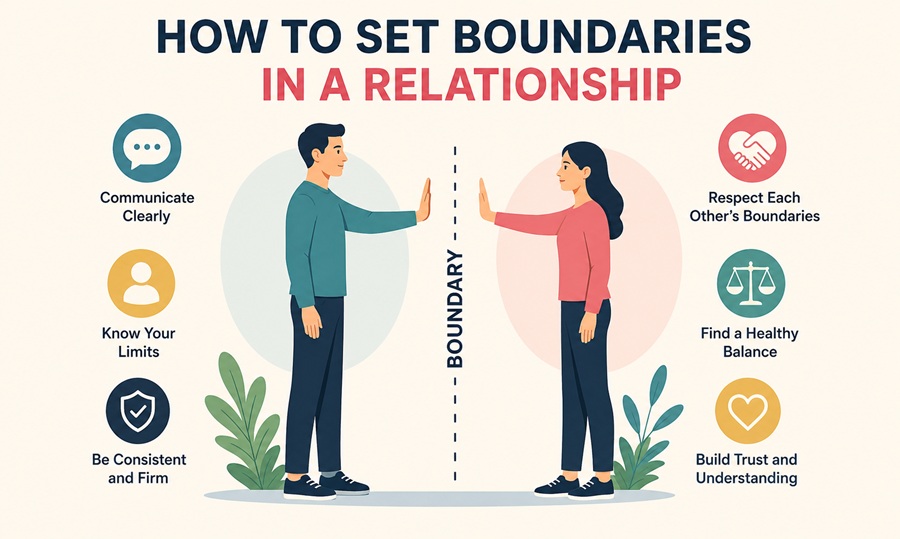
    That pattern — avoiding a direct conversation and managing around a problem instead — is one of the most common reasons boundaries fail before they even get set. A boundary isn’t a wall built to avoid people; it’s a clearly stated limit that tells someone how you need to be treated in order to stay comfortable, safe, and respected in the relationship.

    What Boundaries Actually Are (and Aren’t)

    A boundary is a statement about your own behavior and limits, not a demand for someone else to change who they are. ‘I need us to not raise our voices during disagreements’ is a boundary. ‘You’re not allowed to ever get upset with me’ is not — it’s a control attempt disguised as a boundary. The distinction matters because real boundaries are about what you will and won’t accept or participate in, not about controlling another person’s internal emotional state.

    How to Identify What You Actually Need

    Boundaries usually become clear in hindsight, right after you feel resentment, discomfort, or exhaustion. Pay attention to recurring moments where you feel a small internal flinch — being interrupted constantly, being asked to justify normal decisions, feeling obligated to respond to messages instantly. Each of these discomforts points toward a boundary that hasn’t been stated yet.

    How to Communicate a Boundary Clearly

    State it directly, calmly, and without over-explaining or apologizing excessively. ‘I need some time alone after work before we talk through the day’ is a complete sentence — it doesn’t require three paragraphs of justification. Over-explaining often signals to the other person that the boundary is negotiable, when the goal is to communicate that it isn’t.

    Timing matters too. Bringing up a boundary in the middle of a heated argument rarely lands well; it can come across as a weapon rather than a genuine need. A calmer moment, outside of active conflict, gives the conversation a much better chance of being heard rather than met with defensiveness.

    Following Through Without Guilt

    A boundary without follow-through is just a suggestion. If you’ve said you need space after an argument but keep engaging anyway because you feel guilty, the boundary effectively doesn’t exist. Following through doesn’t require anger — it can be as simple as calmly repeating, ‘I mentioned I need some space right now, let’s talk in a bit,’ and actually stepping away.

    Guilt often shows up here because boundaries can initially disappoint someone who’s used to unlimited access to you. That disappointment is not the same as harm. Learning to sit with someone else’s temporary frustration, without immediately abandoning your own need, is often the hardest and most important part of this whole process.

    When a Partner Consistently Ignores Your Boundaries

    One instance of forgetting is human. A repeated, dismissive pattern of ignoring stated boundaries is different — it’s worth naming directly as its own issue, separate from whatever the original boundary was about. If it continues despite clear, repeated communication, that pattern says more about the relationship’s health than any single disagreement does.

    FAQs

    Q: What’s an example of a healthy boundary?

    ‘I need us to not bring up past mistakes during unrelated arguments’ is a healthy boundary — it addresses your own need for fair conflict without controlling your partner’s emotions.

    Q: Is it selfish to set boundaries in a relationship?

    No, boundaries protect the relationship long-term by preventing resentment from building up silently, which tends to cause far more damage than a direct conversation.

    Q: How do I set a boundary without starting a fight?

    Bring it up calmly, outside of active conflict, using clear ‘I need’ statements rather than accusations framed around the other person’s behavior.

    Q: What if my partner says my boundaries are controlling?

    A genuine boundary focuses on your own limits, not their behavior or identity — if it’s consistently mischaracterized this way despite calm communication, it may be worth discussing with a couples therapist.

    Q: How long does it take for boundaries to feel normal?

    It varies, but most couples adjust to a new boundary within a few consistent repetitions, as long as both people commit to respecting it.

  • Situationship Meaning: Signs, Pros & Cons Explained

    Situationship Meaning: Signs, Pros & Cons Explained

    QUICK ANSWER

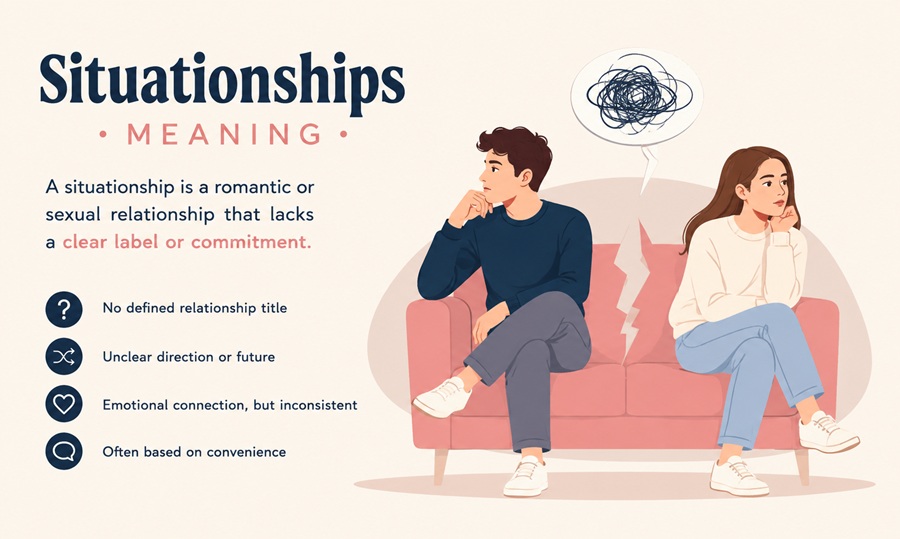
    A situationship is an undefined romantic connection that has elements of a relationship — regular contact, emotional or physical intimacy — without an agreed label, exclusivity, or clear commitment. Unlike casual dating, it often lacks explicit conversation about what the connection actually is.

    Situationship vs. Relationship: Side-by-Side

    Aspect Situationship Relationship
    Labels Undefined, avoided or unclear Explicitly defined (‘boyfriend,’ ‘girlfriend,’ etc.)
    Exclusivity Often unclear or unstated Typically explicit and agreed upon
    Future planning Rarely discussed Regularly discussed and planned for
    Meeting family/friends Uncommon or inconsistent Common and expected over time
    Conflict resolution Often avoided to prevent ‘defining the relationship’ Actively worked through as a couple
    Emotional security Lower, due to ambiguity Higher, due to established commitment

    Situationship vs. Casual Relationship

    These two get confused constantly, but the difference comes down to intentionality. A casual relationship usually involves an actual conversation establishing the terms — both people know it’s casual and have agreed to that. A situationship, by contrast, is defined by its lack of a defining conversation. Nobody has explicitly said what it is; it simply exists in an unlabeled space, often because one or both people avoid the conversation out of fear of ending it.

    Common Signs You’re in a Situationship

    • You’ve been seeing each other regularly for weeks or months with no label
    • Conversations about ‘what we are’ get deflected or joked away
    • You don’t know if you’re exclusive, and you’re afraid to ask
    • Future plans are vague or nonexistent — no discussion of next month, let alone next year
    • You haven’t met each other’s friends or family, despite the frequency of contact
    • The relationship exists mostly through texting and low-effort hangouts rather than real dates

    Pros and Cons

    Potential upsides

    • Lower pressure than a defined relationship, which can suit people not ready for commitment
    • Flexibility to date other people, if that’s mutually understood
    • A low-stakes way to build connection with someone before deciding on more

    Common downsides

    • Persistent uncertainty can create ongoing low-level anxiety
    • Emotional investment often grows unevenly between the two people
    • It can drag on for months without resolution, delaying the search for something more fulfilling
    • Ambiguity makes it hard to plan, introduce them to your life, or feel fully secure

    How to Move Out of a Situationship

    The only reliable exit is a direct conversation. Ask plainly what the other person wants and share what you want in return — not hypothetically, not through jokes, but as a real conversation with a real answer expected. If they consistently avoid the conversation after being asked clearly more than once, that avoidance is itself the answer, even without a spoken ‘no.’

    FAQs

    Q: How long do situationships usually last?

    There’s no set timeline — some resolve within weeks once someone raises the question directly, while others drift on for months or longer without resolution.

    Q: Can a situationship turn into a real relationship?

    Yes, but it requires both people to have a direct conversation and actively choose to define it — it rarely evolves on its own without that step.

    Q: Is it normal to feel anxious in a situationship?

    Yes, the ambiguity itself is often the source of anxiety, since there’s no clear framework for what to expect from the other person.

    Q: How is a situationship different from ‘friends with benefits’?

    Friends with benefits typically implies an agreed physical-only arrangement between people who consider themselves friends, while a situationship is usually more emotionally involved and less clearly defined.

    Q: Should I bring up the label, or wait for them to?

    Waiting indefinitely usually just extends the ambiguity — raising it yourself, calmly and directly, tends to get faster clarity either way.