

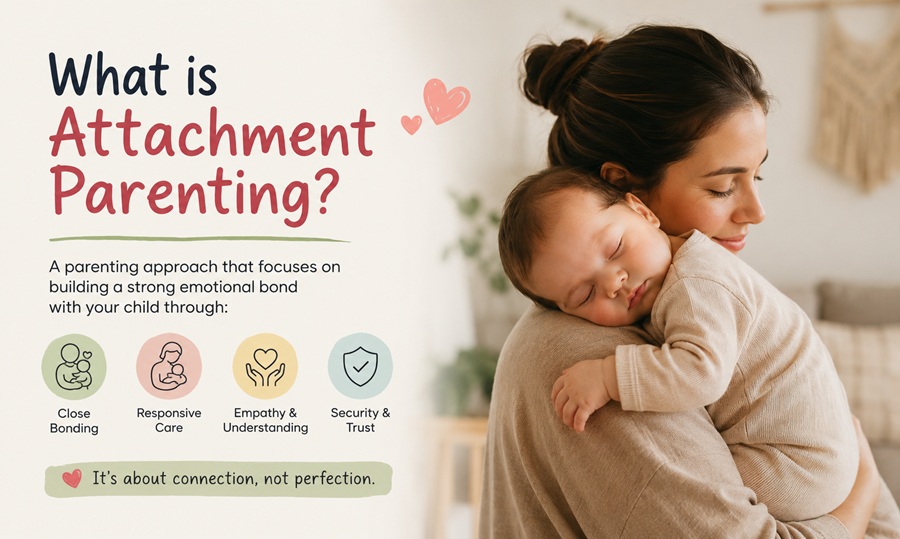
Attachment parenting is a parenting philosophy built around responsiveness and physical closeness. In short: it means meeting your baby’s needs quickly, staying physically close through practices like babywearing and co-sleeping, and building trust through consistent, sensitive caregiving rather than strict schedules.
That’s the quick version. Here’s what it actually looks like in daily life, where it comes from, and how parents make it work without burning out.
Where the Idea Comes From
The term was popularized by pediatrician Dr. William Sears and his wife, Martha Sears, in the 1990s. Their approach draws on attachment theory, a concept originally developed by psychologist John Bowlby, who studied how early bonds between infants and caregivers shape emotional development later in life.
The core idea isn’t new. Many cultures around the world have long practiced constant physical contact with infants, extended breastfeeding, and shared sleeping arrangements. Attachment parenting simply gave these practices a shared name and framework for modern Western parents.
The Core Practices
Attachment parenting isn’t a rigid rulebook, but a few practices show up consistently across most descriptions of it.
Responding promptly to a baby’s cries – Instead of letting an infant “cry it out,” this approach favors picking them up, feeding them, or soothing them right away, especially in the first year.
Babywearing – Carrying your baby in a sling or wrap for much of the day keeps them close, calm, and able to observe the world from a secure position.
Extended breastfeeding – Many attachment parenting families breastfeed well past the first year, sometimes into toddlerhood, following the child’s own pace rather than a set weaning schedule.
Co-sleeping or room-sharing – Babies sleep near or with their parents, often in the same bed or a bedside bassinet, so nighttime needs can be met without long separations.
Gentle discipline – Rather than punishment-based methods, this style leans on redirecting behavior, setting boundaries with empathy, and avoiding spanking or harsh consequences.
Balance and boundaries for parents – Sears also emphasized that parents need to avoid burnout, which is often left out of casual descriptions of the method.
Why Some Parents Choose It
Parents who gravitate toward this style usually want a strong emotional bond with their child from the very beginning. They believe that a securely attached infant grows into a more confident, emotionally regulated child, and research on attachment theory does support the idea that responsive caregiving is linked to healthier emotional outcomes.
Some parents also choose it because it feels more intuitive to them than following a strict schedule. Feeding on demand, sleeping close to the baby, and carrying them frequently can feel like a natural extension of pregnancy and early bonding.
Common Misconceptions
A lot of confusion around attachment parenting comes from oversimplified versions circulating online. A few points worth clearing up:
- It does not mean never putting your baby down. It means responding to their needs, which will naturally include independent play time as they grow.
- It is not the same as permissive parenting. Gentle discipline still involves boundaries; it just avoids punitive methods.
- It doesn’t require co-sleeping for every family. Room-sharing without bed-sharing is a common middle ground, and plenty of parents who identify with attachment parenting principles use a crib.
- It’s not only for stay-at-home parents. Working parents can practice responsive caregiving during the hours they’re with their child, and babywearing or co-sleeping can fit around a job.
What the Research Actually Says
Attachment theory itself is well-supported by decades of developmental psychology research. Secure attachment, meaning a child trusts that a caregiver will respond to their needs, is associated with better emotional regulation and social skills later on.
However, the specific practices promoted under the attachment parenting label, like extended breastfeeding or bed-sharing, are more debated. Bed-sharing in particular carries safety considerations that parents should discuss with a pediatrician, since certain sleep setups increase the risk of suffocation or SIDS. Secure attachment can also be built through consistent, responsive care without adopting every practice associated with the label.
How to Try It Without Overwhelming Yourself
If the philosophy appeals to you but the full package feels like a lot, you don’t have to adopt every element at once.
- Start with responsiveness. Pick your baby up when they cry, and don’t worry about “spoiling” them. Infants can’t be spoiled by attention.
- Try babywearing for part of the day. A simple wrap or structured carrier can free your hands while keeping your baby close.
- Consider room-sharing instead of bed-sharing if safety is a concern. A bassinet next to your bed offers closeness without the same risks.
- Follow your baby’s feeding cues rather than a strict clock, if that fits your lifestyle and pediatrician’s guidance.
- Build in support for yourself. Ask a partner, family member, or friend to take over so you can rest, since attachment parenting works best when the parent isn’t running on empty.
Attachment Parenting vs. Other Styles
Compared to scheduled parenting methods like those found in some sleep-training programs, attachment parenting prioritizes flexibility and responsiveness over predictability and routine. Compared to permissive parenting, it still maintains boundaries, just through connection rather than control. And compared to more hands-off styles, it involves significantly more physical closeness, especially in infancy.
None of these styles is universally “correct.” What works depends on your baby’s temperament, your family’s needs, and your own capacity as a parent.
Frequently Asked Questions
Is attachment parenting the same as gentle parenting?
They overlap but aren’t identical. Gentle parenting focuses more broadly on emotional communication and discipline style across all ages, while attachment parenting centers specifically on infant bonding practices like babywearing, co-sleeping, and extended breastfeeding.
Does attachment parenting create clingy or overly dependent children?
There’s no strong evidence for this. Research on attachment theory generally suggests the opposite: children with secure attachments tend to become more independent as they grow, because they trust that support is available when needed.
Can I practice attachment parenting if I go back to work?
Yes. Many working parents focus on being fully present and responsive during the time they do have with their baby, and practices like babywearing on weekends or breastfeeding before and after work still count.
Is bed-sharing required for attachment parenting?
No. Bed-sharing is one option some families choose, but room-sharing with a separate sleep surface is widely recommended by pediatric safety guidelines and still supports closeness.
What if attachment parenting doesn’t work for my family?
That’s completely normal. Every baby and every parent’s circumstances are different. Taking pieces of the philosophy that fit your life, while leaving out what doesn’t, is a reasonable approach.
Attachment parenting isn’t a strict checklist to complete perfectly. It’s a framework built around one central idea: babies thrive when their needs are met consistently and with warmth. How you get there, whether through babywearing, co-sleeping, extended nursing, or simply responding quickly when your baby needs you, is something each family figures out for itself.