

He texts back three days late. She changes the subject the second things get real. He’s affectionate one week and distant the next, and you can never quite predict which version you’re going to get. If any of this sounds familiar, you’ve probably already brushed up against emotional unavailability, even before knowing the term for it.
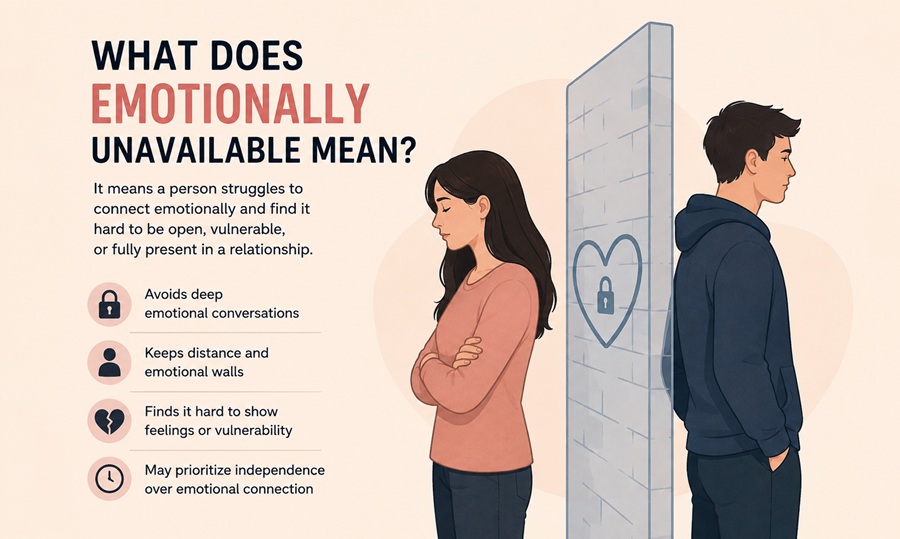
Emotionally unavailable describes someone who struggles to engage fully in emotional intimacy, whether that means expressing feelings, being vulnerable, staying consistent, or fully committing to a relationship. It’s not a diagnosis. It’s a pattern of behavior, and it can show up in mild forms or more serious ones.
The Signs, in Practice
Emotional unavailability rarely announces itself directly. It usually shows up as a collection of smaller patterns.
Inconsistent communication
Long silences followed by sudden warmth, then silence again. It can feel like being on an emotional rollercoaster without ever understanding the schedule.
Avoiding labels or future talk
Conversations about “what we are” or where things are heading get deflected, joked about, or shut down entirely.
Keeping things surface-level
Dates are fun, chemistry might even be strong, but conversations rarely go beyond logistics, humor, or shared activities. Anything deeper gets redirected.
Difficulty with vulnerability
They rarely share fears, insecurities, or past hurts, and may seem uncomfortable when you share yours.
Prioritizing independence over closeness
A strong need for space that goes beyond healthy boundaries, sometimes disappearing emotionally right when things start to feel close.
Mixed signals
Actions and words don’t line up. Someone might say they want a relationship but consistently behave in ways that keep you at a distance.
None of these signs alone confirms emotional unavailability. Most people have an off week or need space occasionally. What matters is the pattern over time, not a single instance.
Why Someone Becomes Emotionally Unavailable
Understanding the “why” doesn’t excuse the behavior, but it does help explain it, and it can shape how you decide to respond.
Past relationship wounds. Someone who was betrayed, cheated on, or hurt badly in a previous relationship may protect themselves by keeping new partners at arm’s length.
Attachment style. People with an avoidant attachment style, often shaped by early relationships with caregivers, tend to value independence highly and feel uncomfortable with too much closeness or dependency.
Fear of vulnerability. Opening up requires risk. For some people, that risk feels too high, especially if past vulnerability was met with rejection or ridicule.
Unresolved personal issues. Grief, unprocessed trauma, or ongoing personal struggles can leave someone with limited emotional bandwidth for a partner, regardless of how they actually feel about the relationship.
Genuinely not ready. Sometimes it’s simpler than a deep psychological pattern. Someone may just not be in a place, due to work stress, life transitions, or personal goals, where they can show up fully for another person right now.
Is It Always a Red Flag?
Not automatically, but context matters a lot.
Someone temporarily emotionally guarded after a rough breakup, who’s communicating that openly and working on it, is different from someone who’s been this way across every relationship they’ve had, with no self-awareness or effort to change.
The distinction usually comes down to two things: self-awareness and effort. Does the person recognize the pattern? Are they doing anything about it, whether that’s therapy, honest communication, or simply trying to be more present? Or is the unavailability treated as a fixed personality trait that you’re expected to accept without question?
What It’s Like to Date Someone Emotionally Unavailable
It often starts with real chemistry. That’s part of what makes it confusing. The connection can feel genuine, even intense at times, which makes the sudden distance harder to make sense of.
Over time, a pattern tends to emerge: closeness followed by a pullback, just enough reassurance to keep you invested, but never quite enough consistency to feel secure. Many people in this situation describe feeling like they’re constantly earning basic effort that should come naturally in a healthy relationship.
This dynamic can be genuinely exhausting, and it often leaves the more emotionally available partner doing most of the relational work, initiating conversations, managing uncertainty, and absorbing inconsistency.
What You Can Do About It
Name the pattern directly
Rather than guessing at what’s going on, a direct but calm conversation about what you’re noticing can clarify a lot. “I’ve noticed we go quiet for a few days and then things pick back up. What’s that about for you?” opens space without accusing.
Watch what happens after you name it
Someone genuinely working through emotional unavailability will usually respond with some acknowledgment, even if imperfect. Someone who dismisses your concerns entirely, or turns it back on you, is showing you something important.
Decide what you actually need
Some people are willing to be patient while someone works through their patterns. Others recognize that they need more consistency than a partner can currently offer, and that’s a valid boundary too.
Don’t take on the project of fixing them
You can be supportive of someone’s growth, but you can’t do that growth for them. A relationship built entirely around waiting for someone to become emotionally available rarely turns out well.
Get clear on your own patterns too
Sometimes people mistake emotional unavailability for someone simply not being into them, or mistake genuine incompatibility for something fixable with enough patience. Self-reflection here matters just as much as reading someone else’s behavior.
When Professional Support Makes Sense
If emotional unavailability is a recurring pattern in your own relationships, not just something you’re noticing in a partner, a therapist can help identify where it comes from and how to build more secure ways of connecting. Similarly, if a partner recognizes this pattern in themselves and wants to change it, therapy focused on attachment and relational patterns is often more effective than trying to work through it alone.
Frequently Asked Questions
Can an emotionally unavailable person change?
Yes, but only with genuine self-awareness and consistent effort, often supported by therapy. Change without any acknowledgment of the pattern is unlikely.
Is emotional unavailability the same as being an avoidant attachment style?
They’re related but not identical. Avoidant attachment is one common cause of emotional unavailability, but the behavior can also stem from grief, past trauma, or simply not being ready for a relationship right now.
How do I know if I’m the emotionally unavailable one?
Signs include discomfort discussing feelings, a strong urge to create distance when relationships get serious, difficulty trusting a partner’s intentions, or a pattern of ending things right as they get close.
Should I keep trying if someone shows signs of emotional unavailability?
That depends on whether you’re seeing any movement or self-awareness over time. Patience without any change eventually becomes one-sided effort, which isn’t sustainable long term.
Is it possible to be emotionally unavailable in some relationships but not others?
Yes. Context, timing, and how safe someone feels with a specific partner can all affect how open they’re able to be, even if a general pattern exists.
Recognizing emotional unavailability isn’t about diagnosing someone from a distance. It’s about noticing patterns clearly enough to decide what you’re willing to accept, and what you actually need from a relationship to feel secure in it.