

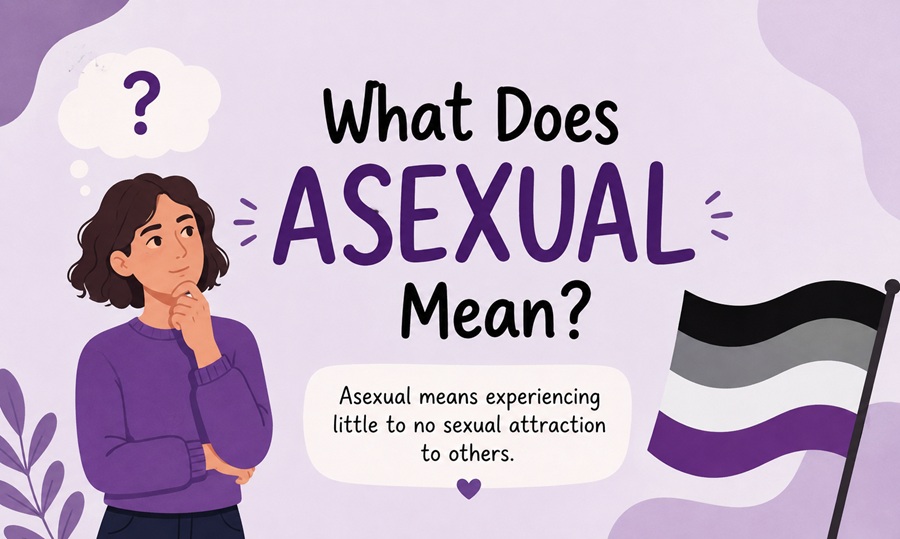
Someone asks if you’re seeing anyone, and you shrug it off with “not really my thing.” Or maybe you’ve noticed a friend never seems interested in dating, and you’re wondering if there’s a word for that. There is: asexual.
Asexual describes someone who experiences little to no sexual attraction to others. It’s not the same as celibacy, and it doesn’t mean someone can’t fall in love, form deep partnerships, or want physical closeness in other forms. It’s specifically about the absence, or low presence, of sexual attraction.
Breaking Down the Definition
Sexual attraction and sexual desire aren’t quite the same thing, and this distinction matters a lot when talking about asexuality.
Sexual attraction is being drawn to someone specifically in a sexual way, wanting them, finding them arousing. Asexual people generally don’t experience this, or experience it rarely and under limited circumstances.
Libido, on the other hand, is a physical drive that some asexual people still have. Someone can be asexual and still masturbate, for example, without that being connected to attraction toward another person.
Romantic attraction is separate again. Many asexual people still want romantic relationships, dating, cuddling, and long-term partnership. They just don’t want sex, or want very little of it, as part of that relationship.
Is Asexuality a Spectrum?
Yes, and this is one of the most important things to understand. Asexuality isn’t an all-or-nothing category. It’s often described as a spectrum, sometimes called the “ace spectrum,” with a lot of variation within it.
- Asexual: Little to no sexual attraction to anyone.
- Graysexual (gray-asexual): Experiences sexual attraction rarely, weakly, or under very specific conditions.
- Demisexual: Only experiences sexual attraction after forming a strong emotional bond with someone.
- Aromantic asexual: Experiences little to no romantic attraction in addition to little to no sexual attraction.
- Asexual and romantic: Experiences romantic attraction (to any gender) while still identifying as asexual.
Someone might identify as asexual and straight, asexual and gay, asexual and bisexual, and so on. Romantic orientation and sexual orientation aren’t locked together.
What Asexuality Is Not
A few clarifications tend to come up often, and they’re worth addressing directly.
Asexuality is not celibacy. Celibacy is a choice to abstain from sex despite still experiencing sexual attraction or desire. Asexuality is an orientation, not a decision made for religious, personal, or practical reasons.
Asexuality is not a hormone problem or a medical condition that needs fixing. Some people confuse low libido caused by medication, illness, or hormonal changes with asexuality, but these are different things. Asexuality is a stable orientation, not a symptom.
Asexuality is not the result of trauma, in the vast majority of cases. While some individuals with trauma histories may also be asexual, research and community consensus don’t support treating asexuality as automatically trauma-related.
Asexuality does not mean someone is incapable of love, intimacy, or long-term commitment. Many asexual people build fulfilling romantic partnerships, marriages, and families.
Common Signs Someone Might Be Asexual
There’s no test or checklist that definitively identifies asexuality, since it’s a matter of self-understanding rather than diagnosis. That said, people who eventually identify as asexual often describe some combination of the following before finding the word:
- Feeling confused or indifferent during conversations where peers talked about attraction or crushes
- Not relating to friends’ descriptions of “wanting” someone sexually
- Enjoying romance, dating, or physical affection like hugging and cuddling, without wanting sex to follow
- Assuming for years that they just hadn’t met “the right person” yet
- Feeling relief rather than confusion after learning the term asexual
None of these alone confirms anything. Self-identification is what matters, and there’s no outside authority that can tell someone whether the label fits.
How Common Is It?
Estimates vary, but asexuality is generally thought to affect somewhere around 1 percent of the population, based on the studies most frequently cited in academic and advocacy sources. Because asexuality often goes unrecognized or misunderstood, some researchers believe the actual number could be higher, as many people may not have encountered the term or considered it as an explanation for their own experience.
How to Support Someone Who Identifies as Asexual
If a friend, partner, or family member comes out as asexual, a few things go a long way.
Believe them. Asexuality is real and well-documented, even if it’s less talked about than other orientations.
Don’t assume it’s fixable or temporary. Comments like “you just haven’t met the right person” are dismissive, even when well-intentioned.
Ask what it means for them specifically, since the spectrum is wide. One asexual person might still want romance and marriage; another might not want a romantic relationship at all.
Respect boundaries in relationships. If you’re dating an asexual partner, open communication about what intimacy looks like for both of you matters more than assumptions.
Can Asexual People Date and Fall in Love?
Absolutely. Many asexual people date, marry, and build long romantic partnerships. Some do so with other asexual partners, avoiding the mismatch entirely. Others date allosexual partners (people who do experience sexual attraction), and these couples often work out arrangements through open communication, whether that means no sexual activity, occasional compromise, or an open relationship structure that works for both people.
There’s no single formula. What matters is that both partners understand and respect where the other stands.
Frequently Asked Questions
Can someone be asexual and still enjoy physical touch?
Yes. Many asexual people enjoy hugging, cuddling, hand-holding, and other forms of non-sexual physical affection. Asexuality specifically concerns sexual attraction, not all physical closeness.
Is asexuality the same as having a low sex drive?
Not necessarily. Libido is a physical drive that can exist separately from attraction. Someone can have a typical libido and still be asexual, since the defining feature is the lack of attraction toward others, not the absence of any sexual sensation.
Can asexuality change over time?
Some people report shifts in how they experience attraction throughout their life, while others feel it stays consistent. Sexual orientation, in general, isn’t necessarily fixed for everyone, though for most people it remains stable.
How do I know if I’m asexual or just haven’t met the right person?
There’s no definitive test. Many asexual people describe going through this exact question before eventually recognizing that the pattern wasn’t about timing or the right partner. Reading personal accounts from the asexual community, sometimes centered around the acronym AVEN (Asexual Visibility and Education Network), can help clarify your own experience.
Is asexuality recognized as part of the LGBTQ+ community?
Yes, asexuality is widely recognized as part of the broader queer community, often represented by the “A” in LGBTQIA+.
Understanding asexuality mostly comes down to separating a few ideas that get bundled together by default: attraction, desire, romance, and behavior. Once those are untangled, the definition becomes much clearer, and so does the wide range of ways asexual people actually live their lives.