
Tag: modern dating terms

  • Situationship Meaning: Signs, Pros & Cons Explained

    Situationship Meaning: Signs, Pros & Cons Explained

    QUICK ANSWER

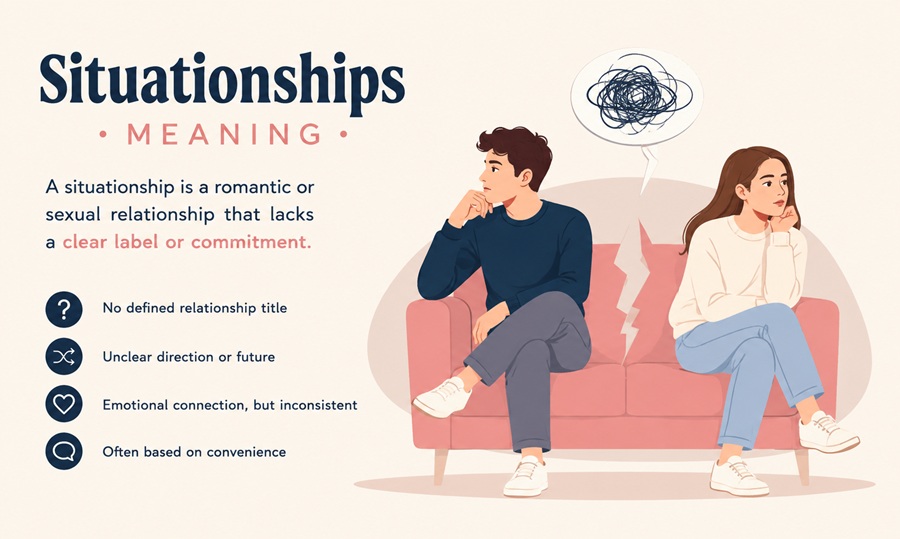
    A situationship is an undefined romantic connection that has elements of a relationship — regular contact, emotional or physical intimacy — without an agreed label, exclusivity, or clear commitment. Unlike casual dating, it often lacks explicit conversation about what the connection actually is.

    Situationship vs. Relationship: Side-by-Side

    Aspect Situationship Relationship
    Labels Undefined, avoided or unclear Explicitly defined (‘boyfriend,’ ‘girlfriend,’ etc.)
    Exclusivity Often unclear or unstated Typically explicit and agreed upon
    Future planning Rarely discussed Regularly discussed and planned for
    Meeting family/friends Uncommon or inconsistent Common and expected over time
    Conflict resolution Often avoided to prevent ‘defining the relationship’ Actively worked through as a couple
    Emotional security Lower, due to ambiguity Higher, due to established commitment

    Situationship vs. Casual Relationship

    These two get confused constantly, but the difference comes down to intentionality. A casual relationship usually involves an actual conversation establishing the terms — both people know it’s casual and have agreed to that. A situationship, by contrast, is defined by its lack of a defining conversation. Nobody has explicitly said what it is; it simply exists in an unlabeled space, often because one or both people avoid the conversation out of fear of ending it.

    Common Signs You’re in a Situationship

    • You’ve been seeing each other regularly for weeks or months with no label
    • Conversations about ‘what we are’ get deflected or joked away
    • You don’t know if you’re exclusive, and you’re afraid to ask
    • Future plans are vague or nonexistent — no discussion of next month, let alone next year
    • You haven’t met each other’s friends or family, despite the frequency of contact
    • The relationship exists mostly through texting and low-effort hangouts rather than real dates

    Pros and Cons

    Potential upsides

    • Lower pressure than a defined relationship, which can suit people not ready for commitment
    • Flexibility to date other people, if that’s mutually understood
    • A low-stakes way to build connection with someone before deciding on more

    Common downsides

    • Persistent uncertainty can create ongoing low-level anxiety
    • Emotional investment often grows unevenly between the two people
    • It can drag on for months without resolution, delaying the search for something more fulfilling
    • Ambiguity makes it hard to plan, introduce them to your life, or feel fully secure

    How to Move Out of a Situationship

    The only reliable exit is a direct conversation. Ask plainly what the other person wants and share what you want in return — not hypothetically, not through jokes, but as a real conversation with a real answer expected. If they consistently avoid the conversation after being asked clearly more than once, that avoidance is itself the answer, even without a spoken ‘no.’

    FAQs

    Q: How long do situationships usually last?

    There’s no set timeline — some resolve within weeks once someone raises the question directly, while others drift on for months or longer without resolution.

    Q: Can a situationship turn into a real relationship?

    Yes, but it requires both people to have a direct conversation and actively choose to define it — it rarely evolves on its own without that step.

    Q: Is it normal to feel anxious in a situationship?

    Yes, the ambiguity itself is often the source of anxiety, since there’s no clear framework for what to expect from the other person.

    Q: How is a situationship different from ‘friends with benefits’?

    Friends with benefits typically implies an agreed physical-only arrangement between people who consider themselves friends, while a situationship is usually more emotionally involved and less clearly defined.

    Q: Should I bring up the label, or wait for them to?

    Waiting indefinitely usually just extends the ambiguity — raising it yourself, calmly and directly, tends to get faster clarity either way.