

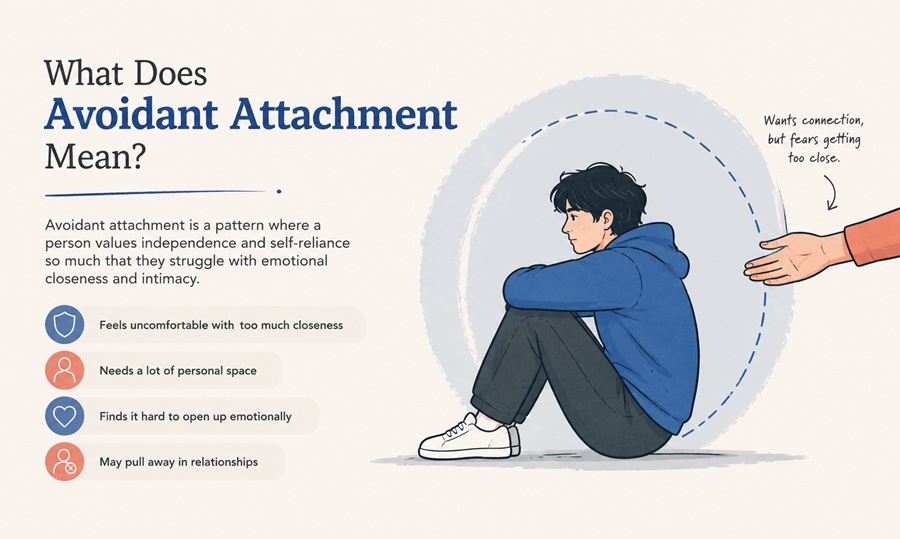
Avoidant attachment describes a pattern where someone learned early on that relying on others wasn’t safe or reliable, so they developed a strong preference for self-sufficiency, emotional distance, and independence over closeness. In relationships, this often shows up as discomfort with vulnerability, a tendency to pull away when things get too intimate, and difficulty asking for support even when it’s needed.
This isn’t a personality flaw or a diagnosis. It’s a relational strategy that made sense at some point, usually in childhood, and later gets applied to adult relationships where it may no longer serve the person well.
Where the Term Comes From
Avoidant attachment is one of the four attachment styles described in attachment theory, a framework originally developed by psychologist John Bowlby and later expanded by researcher Mary Ainsworth through her studies of infants and caregivers. The other three styles are secure, anxious, and disorganized (sometimes called fearful-avoidant).
Attachment theory proposes that the way a child’s caregivers responded to their needs, consistently, inconsistently, or dismissively, shapes how that child expects relationships to work later in life. A child whose emotional needs were regularly brushed aside or discouraged may learn to stop expressing them altogether. That adaptation can carry forward into adult romantic relationships, friendships, and even work dynamics.
Signs of Avoidant Attachment in Adults
Avoidant attachment doesn’t look the same in every person, but several patterns tend to recur:
- Discomfort with emotional intimacy or prolonged closeness
- A strong pull toward independence, sometimes to the point of resisting help
- Difficulty naming or expressing feelings, especially vulnerable ones
- Pulling away or creating distance when a relationship starts to feel serious
- Preferring to solve problems alone rather than lean on a partner
- Feeling smothered by too much affection, check-ins, or emotional expression
- A tendency to focus on a partner’s flaws when things start feeling too close
None of these signs on their own confirm an avoidant attachment style. What matters is the overall pattern and how consistently it shows up across relationships.
Two Common Subtypes
Researchers and clinicians often describe two variations within avoidant attachment.
Dismissive-avoidant attachment involves a genuine preference for independence and a tendency to downplay the importance of close relationships. People with this pattern often see themselves as self-sufficient and may not consciously feel like they’re avoiding anything.
Fearful-avoidant attachment, sometimes called disorganized attachment, combines the desire for closeness with a fear of getting hurt by it. This creates an internal push-pull: wanting connection while also feeling unsafe getting close.
What Causes Avoidant Attachment
Attachment patterns typically form in early childhood, though they can also be reinforced later in life. Common contributing experiences include:
- Caregivers who were emotionally unavailable, dismissive, or discouraged displays of need
- A childhood environment where independence was praised and vulnerability was seen as weakness
- Inconsistent caregiving that taught a child not to expect reliable comfort
- Later experiences, like a painful breakup or betrayal, that reinforced a belief that closeness leads to hurt
It’s worth noting that attachment style isn’t fixed by biology. It’s learned, which also means it can shift with awareness, new relational experiences, and sometimes therapeutic support.
How Avoidant Attachment Shows Up in Relationships
In a romantic relationship, an avoidantly attached partner may seem loving and engaged early on, then create distance as the relationship deepens. This can look like:
- Needing more alone time than the relationship “should” require
- Struggling to say “I love you” or express affection verbally
- Avoiding conversations about the future or defining the relationship
- Responding to conflict by withdrawing rather than working through it
- Feeling relief rather than sadness after a breakup
For a partner with a different attachment style, especially an anxious one, this can feel confusing or rejecting. It often helps both people to understand that the withdrawal is usually a self-protective habit, not a reflection of how much the person cares.
Avoidant Attachment vs. Secure Attachment
A securely attached person also values independence, but the difference lies in flexibility. Someone with secure attachment can lean on a partner during hard times and also function well independently, moving between the two as needed. Someone with avoidant attachment tends to default to distance even when closeness would genuinely help, because vulnerability itself feels threatening.
Avoidant Attachment vs. Anxious Attachment
These two styles often end up paired in relationships, and understanding the contrast explains why that pairing can feel so charged.
An anxiously attached person tends to seek reassurance, worry about a partner pulling away, and feel most settled when a relationship feels close and confirmed. An avoidantly attached person tends to seek space, feel unsettled by too much closeness, and pull back when a relationship starts to feel demanding.
When these two styles end up together, a common cycle forms: the anxious partner reaches for more closeness, the avoidant partner responds by creating distance, which then triggers more anxiety in the first partner, and more withdrawal in the second. Neither person is doing this on purpose. Both are reacting from a learned strategy that, on its own, made sense at some point.
Recognizing this cycle for what it is, a pattern rather than proof that the relationship is doomed, is often the first step toward interrupting it.
Can Avoidant Attachment Change?
Yes, attachment styles are considered changeable, particularly through what’s sometimes called “earned security.” This typically develops through:
- Building self-awareness of avoidant patterns as they happen in real time
- Practicing small moments of vulnerability in safe, low-stakes situations
- Staying present during conflict instead of automatically withdrawing
- Working with a therapist, particularly one familiar with attachment-based approaches
- Being in a relationship with a patient, securely attached partner who doesn’t take the distance personally
Change is usually gradual. It involves unlearning a coping strategy that once felt protective, which takes time and repetition rather than a single insight.
Supporting a Partner With Avoidant Attachment
If you’re the one on the other side of this pattern, a few approaches tend to help more than pushing for closeness directly:
- Give space without disappearing. Distance doesn’t have to mean the relationship is ending.
- Avoid framing withdrawal as proof they don’t care. It’s usually a habit, not a verdict on the relationship.
- Bring up concerns calmly and outside of moments of conflict, when defenses are lower.
- Notice and acknowledge small steps toward vulnerability instead of expecting a sudden shift.
- Take care of your own needs too. Supporting a partner through this shouldn’t come at the cost of your own wellbeing.
When to Consider Professional Support
A therapist can help someone identify where avoidant patterns came from, understand how they show up in current relationships, and build new ways of relating that don’t rely on distance as the default. This can be useful whether someone identifies with the pattern themselves or is trying to understand a partner’s behavior.
Questions worth bringing to a therapist include how early relationships shaped current habits, what specific situations trigger the urge to withdraw, and what small, manageable steps might build more comfort with closeness over time.
Frequently Asked Questions
Is avoidant attachment a mental health disorder?
No. It’s a relational pattern, not a clinical diagnosis. It can coexist with other mental health concerns, but having an avoidant attachment style isn’t itself a disorder.
Can two avoidantly attached people have a healthy relationship?
It’s possible, though both partners may need to work at initiating closeness, since neither may naturally push for more intimacy. Awareness and intentional effort matter more than the starting style.
Is avoidant attachment the same as being an introvert?
No. Introversion is about where someone gets their energy, while avoidant attachment is about comfort with emotional closeness. A person can be introverted and securely attached, or extroverted and avoidantly attached.
Does avoidant attachment mean someone doesn’t love their partner?
Not necessarily. Avoidant behavior is often a self-protective habit rather than a measure of how much someone cares. The withdrawal is usually about managing discomfort with vulnerability, not a lack of feeling.
How do I know if I have an avoidant attachment style?
Look for consistent patterns across multiple relationships, not just one. A therapist or a validated attachment assessment can offer more clarity than self-diagnosis based on a single relationship.
Understanding avoidant attachment isn’t about labeling yourself or a partner. It’s a starting point for recognizing patterns that might be worth examining, especially if the same relationship struggles keep repeating themselves.